Shepherding Color
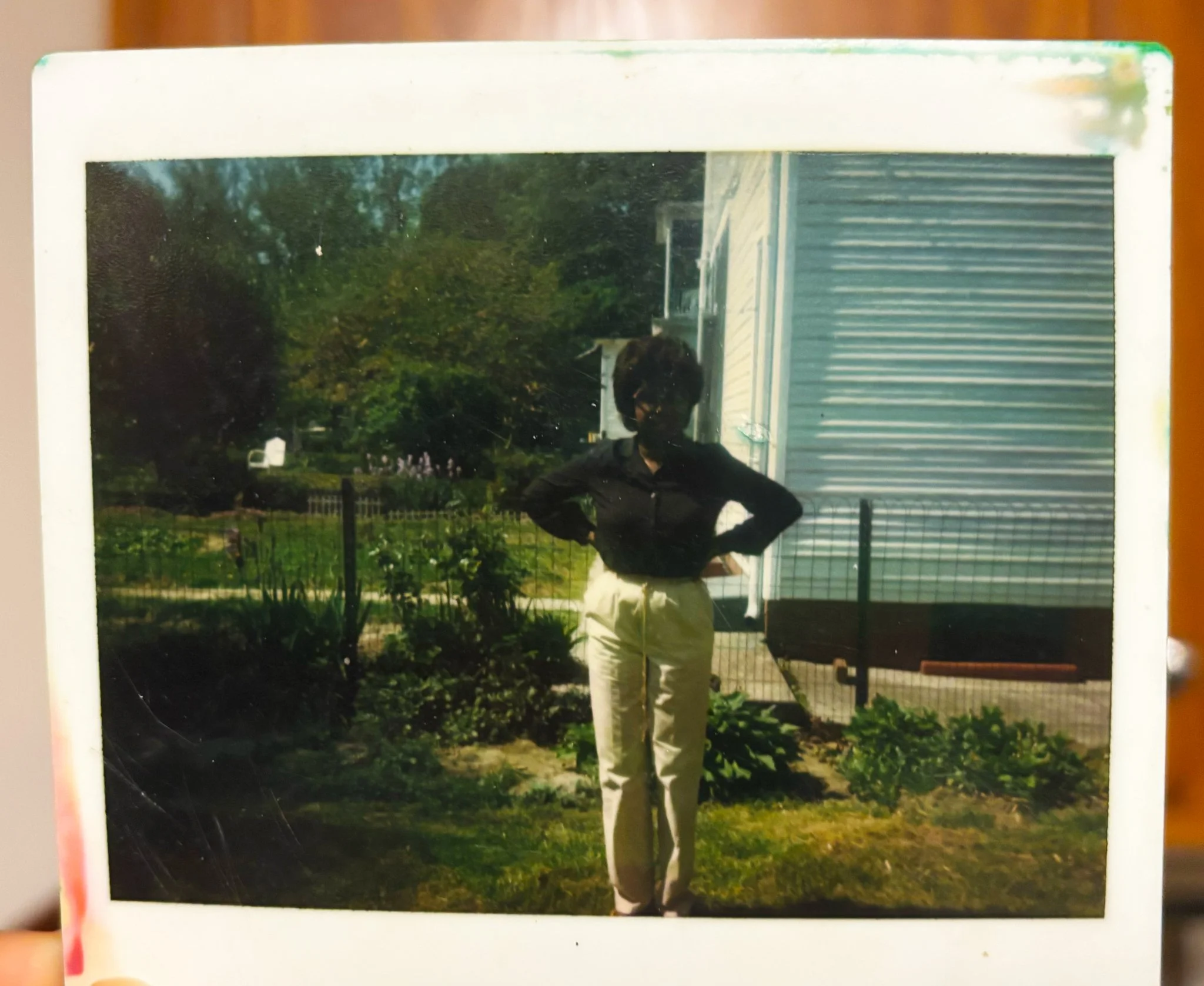
My grandmother in her garden, c.2002 - 2006
My relationship with nature began when I was very young. My grandmother was a gardener; she made beauty in her yard for as long as I can remember, and she made her grandchildren her helpers for just as long. We were taught to sow and weed and mulch and prune, taught the names and nature of the plants and animals that populated the home that our ancestors necessarily adopted in the old south of the United States. For the first part of my life, I lived with intimate knowledge of this small region. Many years later I would move to New York City, graduate from university, and get on with my life working at a desk five days a week doing something that I could convince myself had meaning for me, while losing the threads of that knowledge – as one does. Then the world ended with the COVID-19 pandemic. Like so many young people living and working in the world’s biggest cities at that time, I needed to literally touch grass, to smell the roses, and to do all the other nature clichés that are clichés for a reason.
From this realisation, I started volunteering for an urban community farm, began working as a florist, went to live on an artist-run farm 3 hours north of the city, and started the journey that has led me to where I am today. I am a quilter and textile artist, work that is an extension of my relationship to nature. When critically examined, there is an obvious dotted line between nature work and textiles if one understands fibre and textile histories. Simply put, cellulose fabrics – cotton, linen, hemp, bamboo, etc. – are derived from plants. The fibres are extracted from the plants in a variety of ways, processed, spun into threads, and woven together to create textiles. This is the point at which I show up in the process, dying and manipulating those textiles in service of form and function. This process of manipulation is essential to my work as I attempt to exhaust the uses of traditional natural dyes.
Working with natural dyes sounds nice to any person with an interest in sustainability and a susceptibility to greenwashing. As a practitioner, it can feel righteous to say that something has been “naturally dyed" or “dyed with plants”. I am not unsusceptible to this narrative. More than this, however, my interest in natural dyes is primarily the result of two priorities. The first is a relationship to the past and an idea of creative inheritance informed by second-wave feminist writers and critics like Alice Walker and bell hooks. Cautious of reactionary romanticism, I work with natural dyes out of an interest in intimacy with the makers of the past and acknowledging that what they made and how they made it can inform the future of making. The second priority, and the primary subject of this post, is an abiding interest in process and transformation.
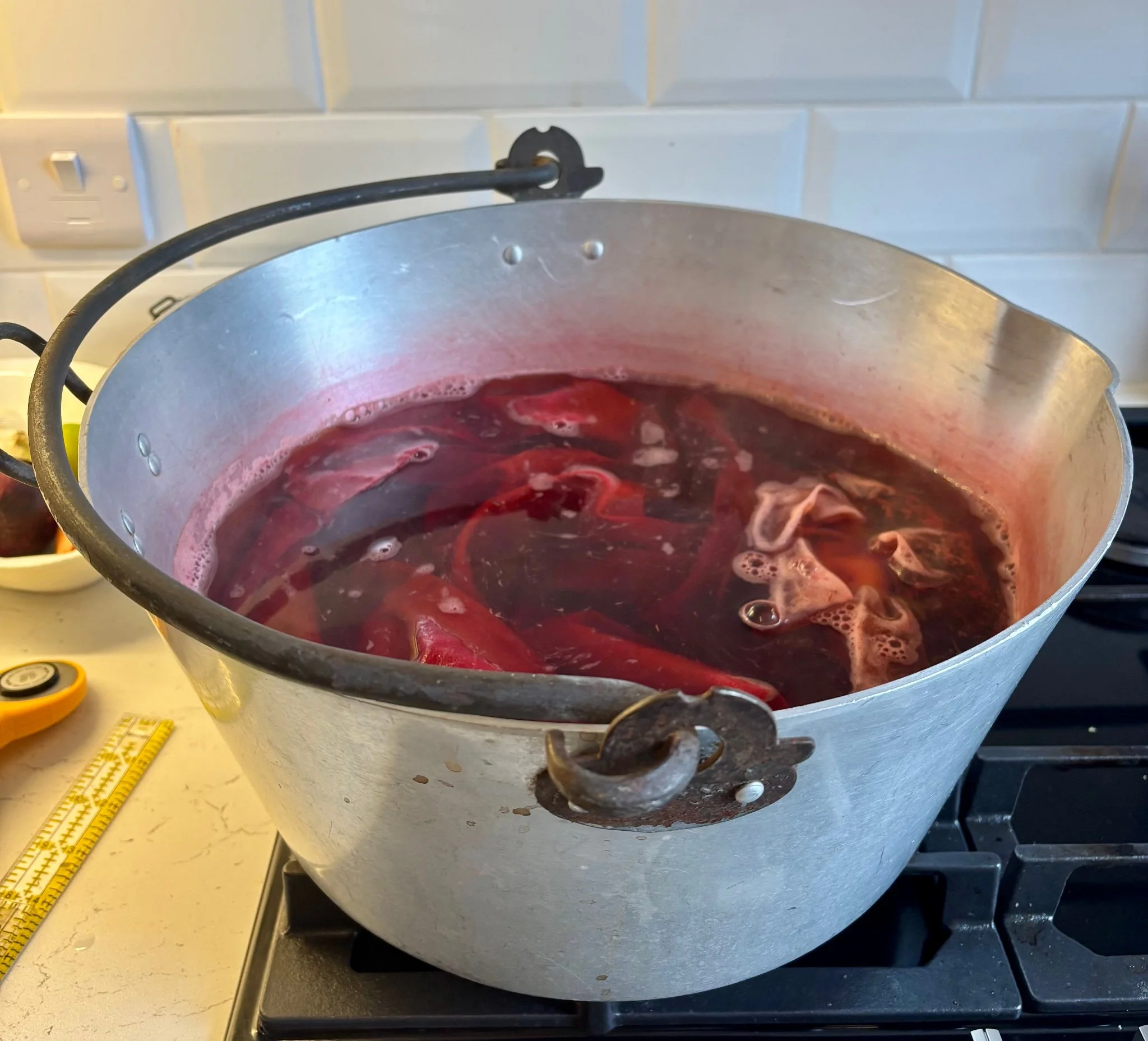
Dyeing is a chemical reaction. It is the process of dye molecules fixing itself onto material. The goal of the natural dye practitioner is to create the conditions under which dye can bond to fibres. Fibres are treated with a mordant, typically a kind of metallic salt. In my practice, that is always aluminium sulphate, plus a bit of sodium bicarbonate (soda ash). Dyes will interact with the aluminium sulphate, creating an insoluble pigment. This mordanting process of treating the fibres with aluminium sulphate and sodium bicarbonate means that this interaction will happen on the fibres. And by adjusting any number of variables – pH levels, fabric weave, temperature, the amount of dyestuff, etc. – one can encounter a whole range of colours. In this process, the practitioner is guiding the transformative interaction between fibre, dye, and a mordant. She is not making colour; she is shepherding it.
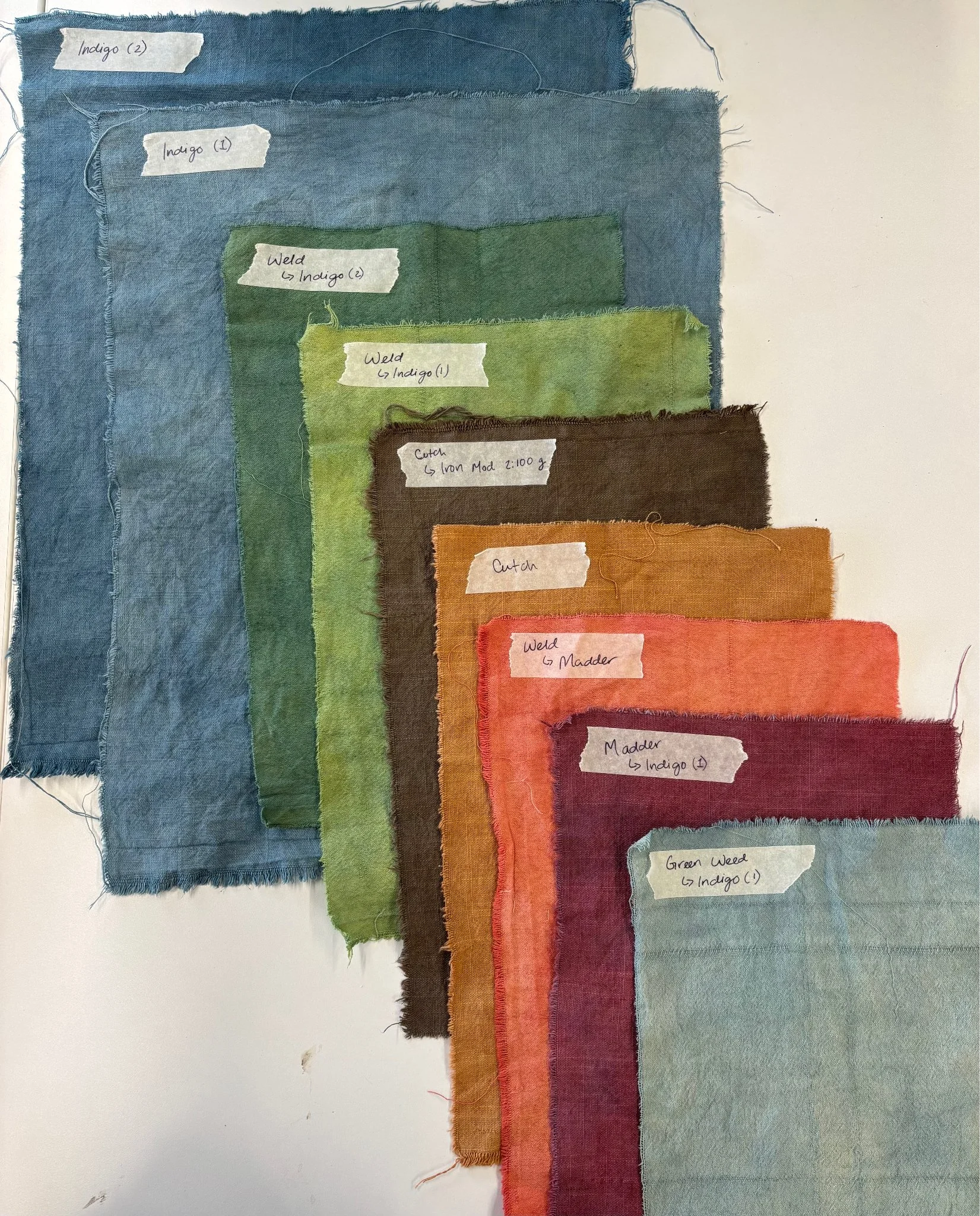
In the dye lab, I feel most comfortable when I perceive myself as a conduit. Understanding natural dyes from this perspective and entering the lab with this point of view has led to an examination of my ego. I feel slightly uneasy when people praise the “my” colours because I don’t feel they belong to me. I feel they belong to the process. The praise of these colours is often accompanied by a bias against the perceived difficulty of working with natural dyes. Designers often decry the “unpredictability” of natural dyes, meaning it can be difficult to exactly replicate specific colourways – an expectation that stems from industrial pigment production. In addition to the perception of unpredictability, the question of lightfastness, or fading, often arises as well. Naturally dyed fabrics are sensitive and necessarily fade and lose some brilliance over time – another expectation that stems from industrial pigment production. These fears are linked to possession and ownership, as opposed to collaboration.
As a florist and a gardener, I learned to not only tolerate the ephemerality but maintain curiosity about it. When I think of the gardeners I know, they speak of the plants they nurture with a sense of pride but not possession. There is the inherent knowledge that the beings which they care for have their own ways. Seasoned gardeners don’t lose sleep over a few seeds that didn’t sprout, or a bulb that doesn’t rise in the spring, or a flower that doesn’t bloom. I try to take this with me into the dye lab: the knowledge that I am not the owner of these processes but the stewardess working in service of them.